Knives and tools for katsuramuki
Use the thinnest, sharpest knife you have with a straight edge of at least 15 cm. The traditional choice is an usuba of 165 to 210 mm; a nakiri is the easiest double-bevel alternative.
The three shapes
What matters in the blade
- Thin behind the edge. The sheet has to slide off one side of the blade while the vegetable stays on the other. A thick blade acts as a wedge and splits or thickens the sheet.
- Straight edge. The edge is held along the length of the piece. A curved belly only touches in one spot, so the sheet comes off uneven.
- Length. The edge has to be longer than the piece of vegetable, with room to stroke. For 8 to 10 cm pieces, 15 cm of edge is the practical minimum.
- Sharpness. More than any other factor. A knife that cuts a sheet of hanging newspaper cleanly is ready; one that catches is not.
Comparing knives
| Knife | Bevel | For katsuramuki |
|---|---|---|
| Usuba, Tokyo style (square tip) | Single | The standard. Thin, flat, straight edge. Needs a left-handed version for left-handed cooks. |
| Kamagata usuba, Osaka style (rounded tip) | Single | Same cut, with a tip that is also useful for decorative work. |
| Nakiri | Double | Very good and easier to sharpen. Fine for both hands. |
| Santoku | Double | Works if thin; the curved tip section is unused. |
| Western chef's knife | Double | Possible, but usually too thick behind the edge and too curved. |
| Vegetable peeler | n/a | Gives short strips, not a continuous sheet. |
Sharpening for this cut
Finish on a medium-fine stone (around 3000 to 6000 grit) so the edge is keen but not so polished that it slides on the daikon skin. On a single-bevel knife, sharpen the bevel side and only flatten the back with a few light strokes; rounding the back makes the knife steer.
Thickness guides
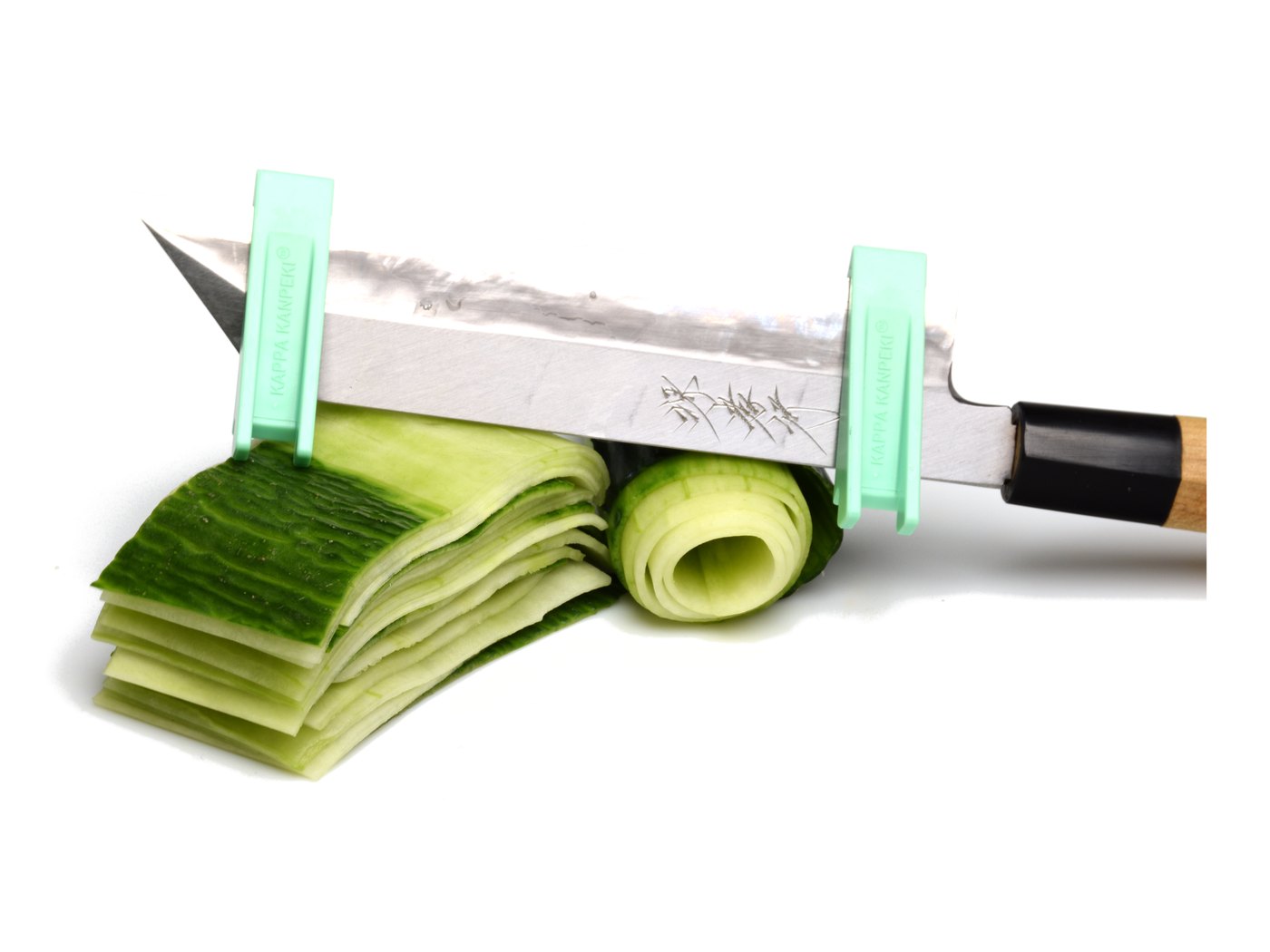
Free-hand katsuramuki is a skill worth having. In a busy kitchen, though, the job is often simply a lot of cucumber or daikon sheets at one thickness, every day. For that, a thickness guide sets the height of the edge for you.
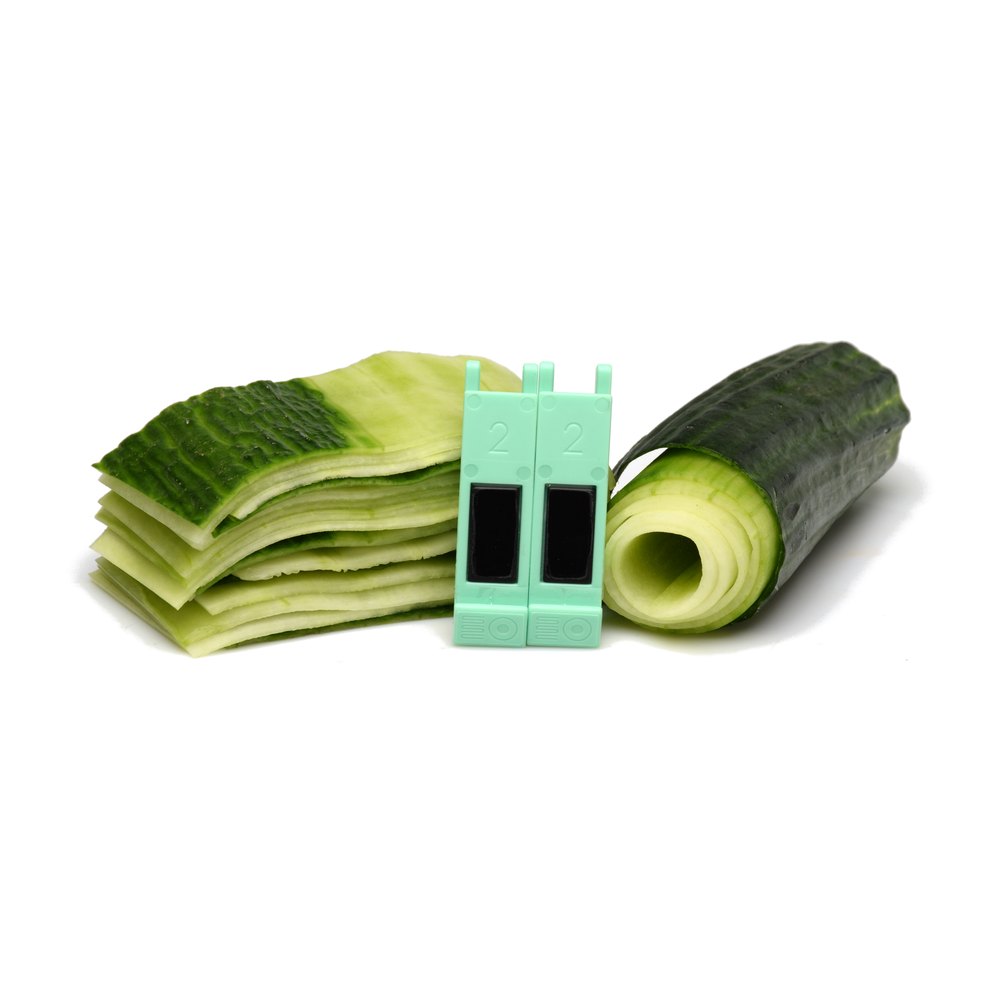
Kappa Kanpeki is a set of magnetic guides that attach to the blade of any kitchen knife 10 cm or longer. The guides rest on the board and hold the edge 1, 2, 3 or 5 mm above it; the vegetable is rolled on the board under the blade and the sheet comes out at that thickness. The 2 mm pair is used for cucumber that is then cut into kappa sticks, the 1 mm pair for daikon tsuma. It does not teach the free-hand cut, and it is not meant to. It is made by Smart Sushi Chef, the shop that runs this site.
Looking for an usuba? Smart Sushi Chef stocks a 210 mm VG-10 usuba by Sakai Kikumori.
Questions
What is the best knife for katsuramuki?
An usuba of 165 to 210 mm. If you do not want a single-bevel knife, a thin nakiri is the best alternative.
Can I use a mandoline instead?
A mandoline gives flat slices across the vegetable, not one continuous sheet around it. Rotary sheet cutters exist for restaurant volume and are a different, much larger machine.